


Sanying Fluid Equipment Co., Ltd. : Your Professional Pneumatic Sanitary Angle Seat Valve Manufacturer!
Sanying Fluid Equipment Co., Ltd. was established in 2010, strategically situated in Wenzhou, China. Our factory dedicated to delivering exceptional valve and pipe solutions with precision and excellence. We are a leading manufacturing and trading combo for sanitary valves, pipe and tank fittings more than 10 years.
-
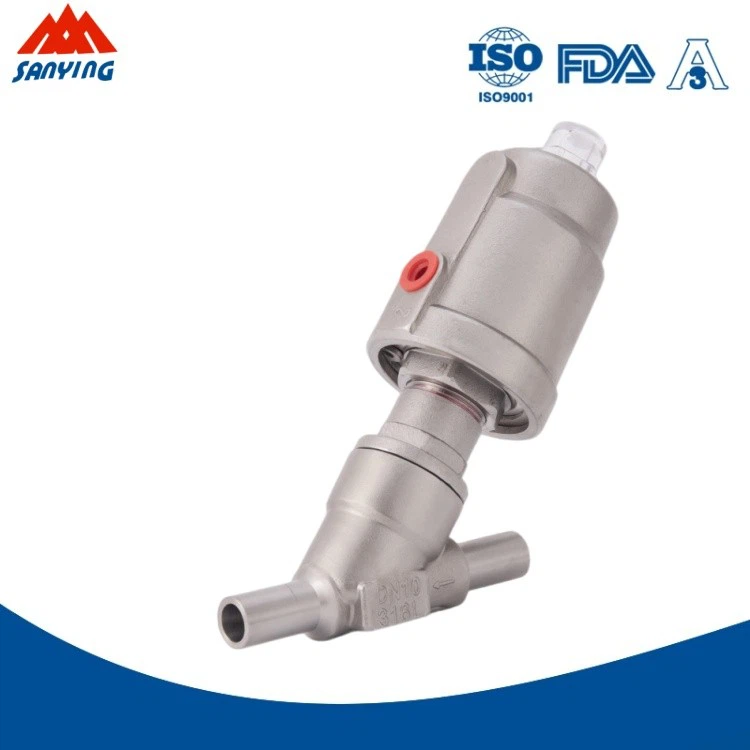
![Pneumatic Cylinder Stainless Steel Angle Seat Valve]() Pneumatic Cylinder Stainless Steel Angle Seat ValveHygienic angle seat valves are an ideal choice for automated fluid control in industries like food & beverage, pharmaceuticals, biotechnology, and cosmetics, offering a perfect balance of hygienic...view more
Pneumatic Cylinder Stainless Steel Angle Seat ValveHygienic angle seat valves are an ideal choice for automated fluid control in industries like food & beverage, pharmaceuticals, biotechnology, and cosmetics, offering a perfect balance of hygienic...view more -
![Weld Pneumatic Stainless Steel Angle Seat Valve]() Weld Pneumatic Stainless Steel Angle Seat ValveHygienic angle seat valves are an ideal choice for automated fluid control in industries like food & beverage, pharmaceuticals, biotechnology, and cosmetics, offering a perfect balance of hygienic...view more
Weld Pneumatic Stainless Steel Angle Seat ValveHygienic angle seat valves are an ideal choice for automated fluid control in industries like food & beverage, pharmaceuticals, biotechnology, and cosmetics, offering a perfect balance of hygienic...view more


Why choose us?
Advanced equipment
Our company specializes in manufacturing high-precision valves and pipeline components for pharmaceutical machinery equipment. The facility features a well-organized layout with dedicated sections for raw material storage, coil processing, CNC machining, precision polishing, professional assembly, and standardized shipping.
Quality control
Each workshop maintains a clean and orderly environment, supported by streamlined processes and close teamwork to ensure strict quality control from raw materials to finished products. We are committed to delivering reliable and efficient solutions that meet industry standards.
Sales market
Our high-standard valves and fittings have been widely adopted across global markets, including Russia, India, Indonesia, Europe, Thailand, South Korea, and Singapore, earning consistent positive feedback for product quality, reliability, and service.
Compact design
The angled configuration allows for space-saving installation in complex piping systems.
Fast actuation
Powered by compressed air, these valves provide quick opening and closing cycles for dynamic processes.
Durability
Constructed from corrosion-resistant materials like stainless steel or brass, ensuring longevity in harsh environments.
Automation compatibility
Easily integrated into PLC-controlled systems for precise process regulation.
Leak-proof sealing
Equipped with resilient seals to prevent fluid or air leakage, enhancing safety and efficiency.
Product Parameters
|
Product name |
Sanitary Pneumatic/Manual Angle Seat Valve |
|
Material quality |
Stainless Steel 316L |
|
Standard |
DIN/ISO/3A |
|
Size available |
1/2inch-4inch |
|
Seal Ring |
PTFE Membrane with FDA 177.2600 |
|
Application |
Pharmacy, Biological, beer, food, dairy, beverage, cosmetic, chemical industry |
Application of Pneumatic Sanitary Angle Seat Valve
Manufacturing industry applications
In manufacturing plants, pneumatic angle valves are indispensable for managing compressed air—the primary power source for countless tools and automated systems. Their ability to precisely regulate airflow ensures consistent operation, reduces energy waste, and supports cost-effective production. These valves are central to maintaining smooth workflow in both discrete and process manufacturing environments.
Automotive industry applications
The automotive sector relies heavily on pneumatic systems for high-precision assembly, testing, and finishing operations. Pneumatic angle valves ensure consistent pressure delivery and rapid actuation, which are crucial for maintaining quality, throughput, and worker safety on production lines.
Agricultural industry applications
In agriculture, automation and resource efficiency are increasingly important. Pneumatic angle valves help modernize farming operations by enabling precise control of water, air, and nutrients, contributing to improved yields and reduced environmental impact.
Our Certificate

Packaging and shipping

We're well-known as one of the most professional pneumatic sanitary angle seat valve manufacturers and suppliers in China for over 15 years. If you're going to buy high quality pneumatic sanitary angle seat valve made in China, welcome to get pricelist and quotation from our factory. We also accept customized orders.
Clamped Pneumatic Sanitary Angle Seat Valve, 3 angle valve seat, angle valve seat