


In fields such as food and beverage, pharmaceutical aseptic production, bioengineering, and cosmetic precision manufacturing that have strict requirements for hygiene level, control accuracy and automation, the sanitary pneumatic three-piece full-wrapped ball valve has become the automatic control hub in the fluid transportation system with its core design of "three-piece structure + pneumatic actuator + full-wrapped seal". The product not only inherits the hygiene advantage of three-piece structure which is easy to disassemble and clean, but also realizes fast and precise start-stop control of fluid through high-precision pneumatic actuator. It perfectly adapts to key processes such as CIP (Clean-in-Place) and SIP (Sterilization-in-Place), effectively avoids manual operation errors, and provides stable and reliable fluid control solutions for continuous and automatic production scenarios.
Core Product Advantages
1. Pneumatic Actuation System for More Accurate Automatic Control
①High-Speed Response Feature: Equipped with imported pneumatic actuator, adopting piston-driven principle, the opening and closing response time is only 0.3-0.8 seconds (depending on the diameter), which can quickly respond to the control system signal, realize instant on-off of fluid, and adapt to the high-frequency switching demand of the production line. The actuator has a built-in return spring, supporting two modes: single-acting (air failure reset) or double-acting (air failure holding) to meet different safety control requirements.
②Stable Output Torque: The actuator torque output range is 5-500N·m, which is accurately matched according to the valve diameter, ensuring stable opening and closing under high and low pressure working conditions without jamming or overshoot. Equipped with torque adjustment device, the output torque can be fine-tuned according to actual working conditions, avoiding wear caused by excessive extrusion of seals and prolonging the seal life.
③Intelligent Status Feedback: Optional accessories such as limit switch, solenoid valve and positioner can be equipped to realize real-time feedback and remote monitoring of valve opening and closing status. The positioner supports 4-20mA analog signal control, which can realize the proportional adjustment function of the valve, accurately control the fluid flow, and adapt to the process scenarios that require fine flow adjustment (such as liquid medicine proportioning in pharmaceutical industry).
2. Three-Piece Full-Wrapped Structure for More Efficient Hygiene Maintenance
①Dead-Corner-Free Disassembly Design: Adopts a three-piece combined structure of valve body, left valve cover and right valve cover, connected by food-grade stainless steel bolts, which can be completely disassembled without special tools. After disassembly, the valve inner cavity, ball and seals are completely exposed, and can be cleaned by ultrasonic or sterilized by steam to completely remove residual medium and avoid cross-contamination.
②Double Seal Protection: The ball adopts full-wrapped PTFE/EPDM seal structure, the seal fits closely to the ball surface to realize two-way zero leakage; the valve stem adopts multi-layer gasket ring seal + dust ring design, which not only prevents medium leakage, but also isolates external dust from entering the valve inner cavity, adapting to the GMP Class A environment requirements of clean workshop.
③Low-Resistance Flow Channel Design: The valve body adopts a symmetrical straight-through flow channel with a fluid resistance coefficient ≤0.07, ensuring smooth medium flow without stagnation. The transition between the flow channel and the valve body is treated with arc chamfering to avoid medium residue, and at the same time ensure that CIP cleaning fluid and SIP sterilization steam can fully cover every part of the flow channel, completely eliminating sanitary dead ends.
3. Top Sanitary Materials for More Comprehensive Safety Adaptation
①Corrosion-Resistant Substrate Selection: Core components in contact with the medium, such as valve body, valve cover and ball, are made of 304/316L food-grade stainless steel. 316L material contains molybdenum, which has better intergranular corrosion and pitting corrosion resistance than 304. It can be safely adapted to complex media such as acid (such as citric acid solution), alkali (such as sodium hydroxide solution) and high salt (such as pickling solution), ensuring that the medium is not contaminated by the material.
②Mirror Polishing Process: The valve inner cavity, flow channel and ball surface are treated with high-precision mechanical polishing + electrochemical polishing, with a surface roughness of Ra≤0.8μm (Ra≤0.5μm can be customized for aseptic working conditions), presenting a mirror effect. This process can effectively reduce microbial attachment points, reduce the risk of bacterial growth, and fully comply with international hygiene standards such as GMP, FDA 21 CFR 177.2600.
③Food-Grade Seal Configuration: Seals are made of FDA-certified food-grade silicone, EPDM or PTFE, with no odor and no component migration, and no harmful substances are produced when in contact with food, pharmaceuticals and other media. Among them, PTFE seals can withstand high temperature of -20℃-+180℃, adapting to high-temperature sterilization process; silicone seals have excellent elasticity and more stable sealing performance.
Specifications
|
Parameter Category |
Specific Specification |
Remarks |
|
Nominal Diameter |
DN10 - DN150 (1/4" - 6") |
Custom non-standard diameters available |
|
Nominal Pressure |
PN10 - PN25 |
Working pressure: 1.0MPa - 2.5MPa (water at 20℃) |
|
Operating Temperature Range |
-40℃ - +180℃ |
Silicone: -40℃-+120℃; EPDM: -40℃-+150℃; PTFE: -20℃-+180℃ |
|
Valve Body & Cover Material |
304 Stainless Steel, 316L Stainless Steel |
316L recommended for corrosive/aseptic working conditions |
|
Ball Material |
304/316L Stainless Steel (Hardened) |
Surface hardness: HRC58 - 62; precision grinding |
|
Seal Material |
FDA Certified Silicone, EPDM, PTFE |
Meet food & pharmaceutical contact safety standards |
|
Pneumatic Actuator Type |
Piston Type (Single-Acting/Double-Acting) |
Aluminum alloy shell, anodized treatment |
|
Air Supply Pressure |
0.4MPa - 0.8MPa |
Recommended: 0.5MPa - 0.6MPa for stable operation |
|
Response Time |
0.3s - 0.8s |
DN10-DN50: ≤0.5s; DN65-DN150: ≤0.8s |
|
Actuator Torque Range |
5N·m - 500N·m |
Matched according to valve diameter and pressure level |
|
Connection Type |
Clamp-type, Threaded (G/NPT), Flanged |
Clamp: ISO/DIN/SMS; Flange: PN10/PN16; Thread: G1/4"-G2" |
|
Surface Roughness |
Ra≤0.8μm (Optional Ra≤0.5μm) |
Inner cavity & ball surface (tested by roughness meter) |
|
Sealing Performance |
Bidirectional Zero Leakage |
Tested with 1.1 times nominal pressure water |
Product Features
1.Ultimate Sanitary Design
- High - quality Materials: The valve body is made of 304/316L stainless steel, which has excellent corrosion resistance and can effectively prevent chemical reactions with the medium, ensuring that the medium is not contaminated.
- Smooth Surface Treatment: The inner cavity of the valve body and all components in contact with the medium are processed by high - precision mechanical polishing and electrochemical polishing. The surface roughness is Ra≤0.8μm, and in some cases, Ra≤0.5μm, presenting a mirror - like effect. This can effectively prevent the attachment and growth of microorganisms and facilitate thorough cleaning and sterilization.
- Dead - free Flow Path: The straight - through flow path design and optimized internal structure allow the fluid to pass smoothly without stagnant areas. During CIP (Clean - in - Place) and SIP (Sterilization - in - Place) processes, the cleaning solution and steam can comprehensively and thoroughly flush the entire flow path, eliminating sanitary dead corners and meeting strict sanitary standard requirements.
Installation & Operation Details
1.Pre-Installation Preparation
①Parameter & Appearance Check: Confirm that the valve model, nominal diameter, pressure level and actuator type match the system requirements. Check that the valve surface has no scratches, the seal is intact without deformation, and the actuator air port is clean without blockage. For aseptic working conditions, check the polishing quality and certification documents.
②Pipeline & Tool Preparation: Thoroughly clean the pipeline inner wall to remove welding slag, rust and debris (use high-pressure water flushing for food pharmaceutical industry). Prepare tools according to connection type: clamp wrench, torque wrench, food-grade sealant (for threaded connection), and air source with pressure gauge (0.4-0.8MPa) for actuator test.
③Actuator Pre-Test: Connect the air source to the actuator (ensure the air is filtered and dried), test the opening and closing action 3-5 times. Check that the actuator responds quickly without jamming, and the limit switch (if equipped) feeds back the status correctly.
2.Installation Steps
①Positioning & Alignment: Place the valve between the pipeline connections, ensure that the flow direction mark on the valve body is consistent with the medium flow direction. For flanged connection, ensure the bolt holes are aligned; for clamp connection, ensure the flange end faces are flush.
②Seal Installation: Place the food-grade seal gasket (provided with the valve) on the valve connection face, ensure the gasket is centered without
deviation. Do not use non-food-grade gaskets to avoid medium contamination.
③Connection & Fixing: Clamp Connection: Put the clamp on the flange, ensure it covers the flange boss, and tighten the clamp bolts evenly with a wrench until a "click" sound is heard (indicating in place). Threaded Connection: Wrap 2-3 turns of food-grade Teflon tape on the external thread (clockwise direction), tighten evenly with a torque wrench (DN10-DN25: 15-20N·m; DN32-DN50: 25-30N·m). Flange Connection: Pass the bolts through the holes, tighten evenly in 3 times using diagonal method. Final torque: PN10 (20N·m), PN25 (35N·m).
④Air Source Connection: Connect the air pipe to the actuator air port (mark "P" for air inlet, "A/B" for working ports). Install a filter regulator between the air source and the valve to remove water and impurities in the air.
⑤Post-Installation Test:
①Actuation Test: Send control signals to test 10 times of opening and closing, check that the action is smooth and the status feedback is accurate.
②Pressure Test: Inject 1.1 times nominal pressure water into the pipeline, hold pressure for 30 minutes, no leakage at connections and valve stem.
③ CIP/SIP Test: Conduct empty CIP/SIP cycle once, check that the flow channel is unobstructed and the seal is resistant to high temperature
3.Operation & Maintenance Points
①Operation Specifications: Do not exceed the maximum air supply pressure (0.8MPa) to avoid actuator damage; when conducting SIP sterilization, ensure the actuator is disconnected from the air source and the valve is fully open. After sterilization, cool to room temperature before operating to avoid thermal deformation of seals.
②Regular Inspection: Daily check the air source pressure and seal leakage; weekly check the actuator action and limit switch feedback; monthly clean the filter regulator and check the seal aging; quarterly conduct pressure test and polish the valve inner cavity if necessary.
③Seal Replacement: Replace seals every 6-12 months (shorten for corrosive/high-temperature working conditions). When replacing, disassemble the valve according to the three-piece structure, clean the inner cavity with purified water, and install new FDA-certified seals (ensure no impurities adhere).
④Actuator Maintenance: Every 6 months, add food-grade lubricating oil to the actuator piston (avoid oil contact with medium); if the action is slow, check the air source pressure and clean the air filter; replace the actuator spring if there is reset failure.
Typical Application Scenarios
Food and Beverage Industry
Used for fluid control in raw material transportation, blending, filling and other links in the production of dairy products, fruit juices, beer, drinking water, etc. It can withstand the scouring of CIP cleaning fluid to ensure food hygiene and safety.
01
Pharmaceutical Industry
Suitable for key processes such as purified water systems, liquid preparation, and aseptic filling. It meets GMP certification requirements, has no sanitary dead ends, and can realize SIP online sterilization to avoid cross-contamination of drugs.
02
Bioengineering Field
Used in cell culture, fermentation broth transportation, biological preparation production and other links. The material has no biological toxicity and high surface smoothness, which can prevent microbial adhesion and ensure the activity of biological products.
03
Cosmetics Industry
Suitable for raw material transportation and production process control of essences, lotions, creams, etc. The seals have no peculiar smell and no component migration, ensuring stable cosmetic quality
04
Chemical Industry
Used for transportation control of weakly corrosive chemical raw materials and solvents. The combination of 316L material and PTFE seal can improve corrosion resistance and adapt to complex chemical working conditions.
05
Certificates

Company Profile
| Production Lines |
Stainless steel sanitary pipe fittings' line, machining line, sanitary manhole line, |
|
|
Product Range |
Sanitary diaphragm valve, sanitary check valve, sanitary ball valve, sanitary sampling valve,sanitary tank bottom valve,sanitary radial tank bottom diaphragm valve,sanitary angle seat valve,sanitary butterfly valve,sanitary check valve |
|
|
Year Established |
2014 |
|
|
Factory Size in Square Meters |
14000M2 |
|
|
NO. OF TOTAL STAFF |
130 |
|
|
Production Capital |
8 000 000 USD |
|
|
Detail capacity |
Diaphragm valve |
1000000nos |
|
Pipe fittings |
150000nos |
|
|
Ferrules, unions, connectors |
200000nos |
|
|
Ball valves |
15000nos |
|
|
Butterfly valves |
20000nos |
|
|
Investment in Manufacturing Equipment |
750000USD |
|
|
Details of equipment |
For machining parts |
|
|
Primary Competitive Advantages |
Strict inspection, honest business way, fast revert on order problem |
|
|
Stocked materials |
Big quantity for raw forging of butterfly valve, diaphragm valve, ferrule, union, adapters, pipe fittings, clamps, sight glass, safety valve, manhole cover, tee,elbow,check valves,sample valve,angle seat valve,CIP spray cleaning ball,SMS Union,Clamped Unions,Strainer/fliter |
|
|
OEM Services Provided |
Yes |
|
|
Design Service Offered |
Yes |
|
|
Sales Volume |
6 000 000 USD |
|
|
Export Percentage |
80% |
|
|
MAIN MARKET |
USA, Germany, Vietnam, Pakistan,Russia,Canada, Thailand, Korea, South Africa, Indonesia, Saudi, India, New Zealand, Australia, Middle East,... |
|
|
Own Brand Name |
Sanying |
|
Feedback From Customers

★★★★★ Full star Review!!!
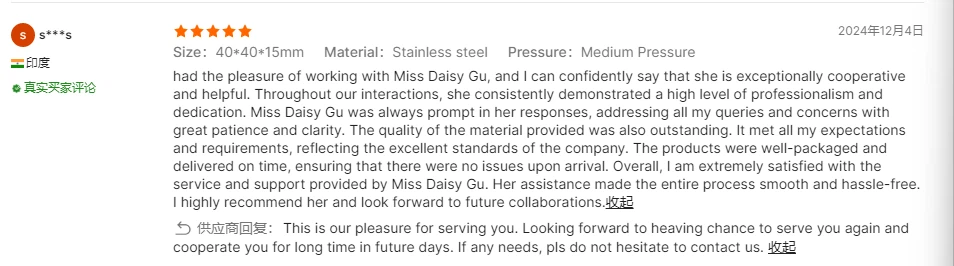
Had the pleasure of working with Miss Daisy Gu, and l can confidently say that she is exceptionally cooperative and helpful. Throughout our interactions, she consistently demonstrated a high level of professionalism and dedication. Miss Daisy Gu was always prompt in her responses, addressing all mygueries and concerns with great patience and clarity. The quality of the material provided was alsooutstanding, it met all my expectations and reauirements, reflectina the excellent standards of thecompany. The products were well-packaged and delivered on time, ensuring that there were no issuesupon arrival. Overall, l am extremely satisfied with the service and support provided by Miss Daisy Gu. Helassistance made the entire process smooth and hassle-free. l highly recommend her and look forward tofuture collaborations.
Satisfecha con la compra. excelente servicio del proveedor. muy buen seguimiento del proveedor.
Las piezas seven debuena calidad.
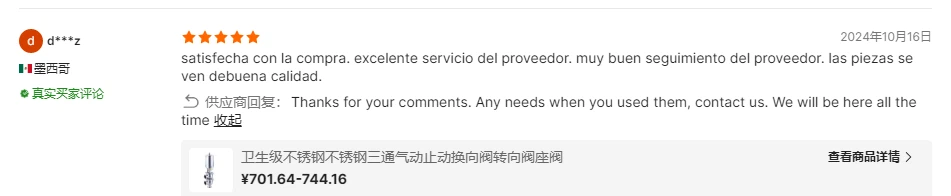

Satified with the Quality and all the service. Everything is Good!!
FAQ
Hot Tags: pneumatic sanitary three piece body ball valve, China pneumatic sanitary three piece body ball valve manufacturers, suppliers, factory, 3pcs ball valve, Manual Clamped Sanitary 3PCS Ball Valve, Manual Weld Sanitary 3PCS Ball Valve, Pneumatic Sanitary 3PCS Ball Valve, sanitary ball valve


