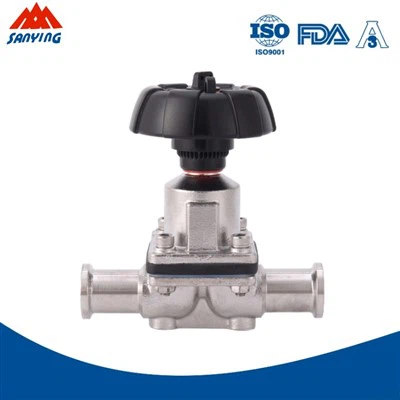
Hey there! As a supplier of forged sanitary diaphragm valves, I often get asked about the flow coefficient of these valves. So, I thought I'd take a few minutes to break it down for you and explain what it means, why it matters, and how it affects the performance of our valves.
Let's start with the basics. The flow coefficient, often denoted as Cv, is a measure of a valve's ability to pass fluid. In simple terms, it tells you how much water (in US gallons per minute) can flow through a valve at a pressure drop of 1 psi. The higher the Cv value, the more fluid the valve can handle. It's a crucial factor when you're choosing a valve for your specific application because it directly impacts the efficiency and effectiveness of your system.
Now, you might be wondering, "Why is the flow coefficient so important for forged sanitary diaphragm valves?" Well, in sanitary applications, such as in the food, beverage, pharmaceutical, and biotechnology industries, precise control of fluid flow is essential. These industries have strict hygiene and quality standards, and any deviation in flow can lead to product contamination, inconsistent product quality, or even equipment damage. That's where our forged sanitary diaphragm valves come in. They're designed to provide accurate and reliable flow control, and the flow coefficient plays a key role in achieving that.
When it comes to our forged sanitary diaphragm valves, we've engineered them to have optimal flow coefficients for a wide range of applications. Our valves are made from high - quality forged materials, which not only ensures their durability but also allows for smooth internal surfaces. This smoothness reduces turbulence and pressure drop, resulting in a higher flow coefficient. In other words, our valves can handle more fluid with less energy loss, which translates to cost savings and better system performance.
Let's talk about how the design of our forged sanitary diaphragm valves affects the flow coefficient. The diaphragm in these valves acts as a flexible barrier that separates the fluid from the valve's operating mechanism. When the valve is open, the diaphragm retracts, allowing fluid to flow through. The shape and flexibility of the diaphragm are carefully designed to minimize resistance to flow. A well - designed diaphragm can open fully and smoothly, enabling a large volume of fluid to pass through with minimal obstruction. This design feature contributes to a higher flow coefficient.
Another important aspect is the valve's port size. We offer a variety of port sizes in our forged sanitary diaphragm valves to meet different flow requirements. Generally, larger port sizes result in higher flow coefficients because they provide a larger cross - sectional area for the fluid to flow through. However, it's not just about the size; the internal geometry of the valve also matters. Our engineers have optimized the internal shape of the valve body to ensure that the fluid can flow through the port in the most efficient way possible.
Now, I'd like to introduce you to some of our popular forged sanitary diaphragm valve products. We have the 3A Weld Manual Sanitary Hygienic Diaphragm valve. This valve is designed for applications where a welded connection is required. It has a smooth and clean internal surface, which is ideal for sanitary applications. The welding process ensures a leak - free connection, and the valve's design provides a high flow coefficient, making it suitable for high - flow applications.
We also have the 3A Forged GEMU Replaced Sanitary Diaphragm Valve. This valve is a great option if you're looking to replace an existing GEMU valve. It's designed to be a direct replacement, but with the added benefits of our advanced design and optimized flow coefficient. It offers excellent flow control and is easy to install and maintain.
And then there's the 3A Thread Manual Sanitary Hygienic Diaphragm Valve. This valve is perfect for applications where a threaded connection is preferred. It has a simple and reliable design, and the threaded connection allows for easy installation and disassembly for cleaning and maintenance. Despite its compact size, it still offers a good flow coefficient, making it suitable for a variety of low - to medium - flow applications.
When you're calculating the flow coefficient for your specific application, there are a few things you need to consider. First, you need to know the required flow rate of your system. This is the amount of fluid that needs to pass through the valve per unit of time. You also need to know the pressure drop across the valve. Pressure drop is the difference in pressure between the inlet and the outlet of the valve. Using these values, you can calculate the required Cv value for your valve. If you're not sure how to do the calculations, our technical support team is always here to help.
In addition to the flow coefficient, there are other factors that can affect the performance of our forged sanitary diaphragm valves. Temperature, viscosity of the fluid, and the type of fluid itself can all have an impact. For example, if you're dealing with a highly viscous fluid, the flow coefficient might be lower because the fluid has more resistance to flow. Our valves are designed to handle a wide range of fluid viscosities, but it's important to choose the right valve for your specific fluid.
So, if you're in the market for a forged sanitary diaphragm valve, don't overlook the importance of the flow coefficient. It's a key factor that can make or break the performance of your system. Our forged sanitary diaphragm valves offer excellent flow coefficients, along with the high - quality construction and sanitary design that you need for your critical applications.
If you're interested in learning more about our products or need help choosing the right valve for your application, we'd love to hear from you. Just reach out to us, and our team of experts will be happy to assist you with all your valve - related needs. Whether you need detailed product information, technical support, or a quote, we're here to make the process as easy as possible for you.


In conclusion, the flow coefficient of our forged sanitary diaphragm valves is a critical aspect that sets them apart in the market. It's a result of our commitment to quality, innovation, and customer satisfaction. We're constantly working to improve our products and ensure that they meet the ever - evolving needs of our customers in the sanitary industries. So, if you're looking for a reliable and efficient solution for your fluid flow control needs, give our forged sanitary diaphragm valves a try.
References
- "Valve Handbook" by Valve Manufacturers Association
- Industry standards for sanitary valves in food, beverage, pharmaceutical, and biotechnology industries.